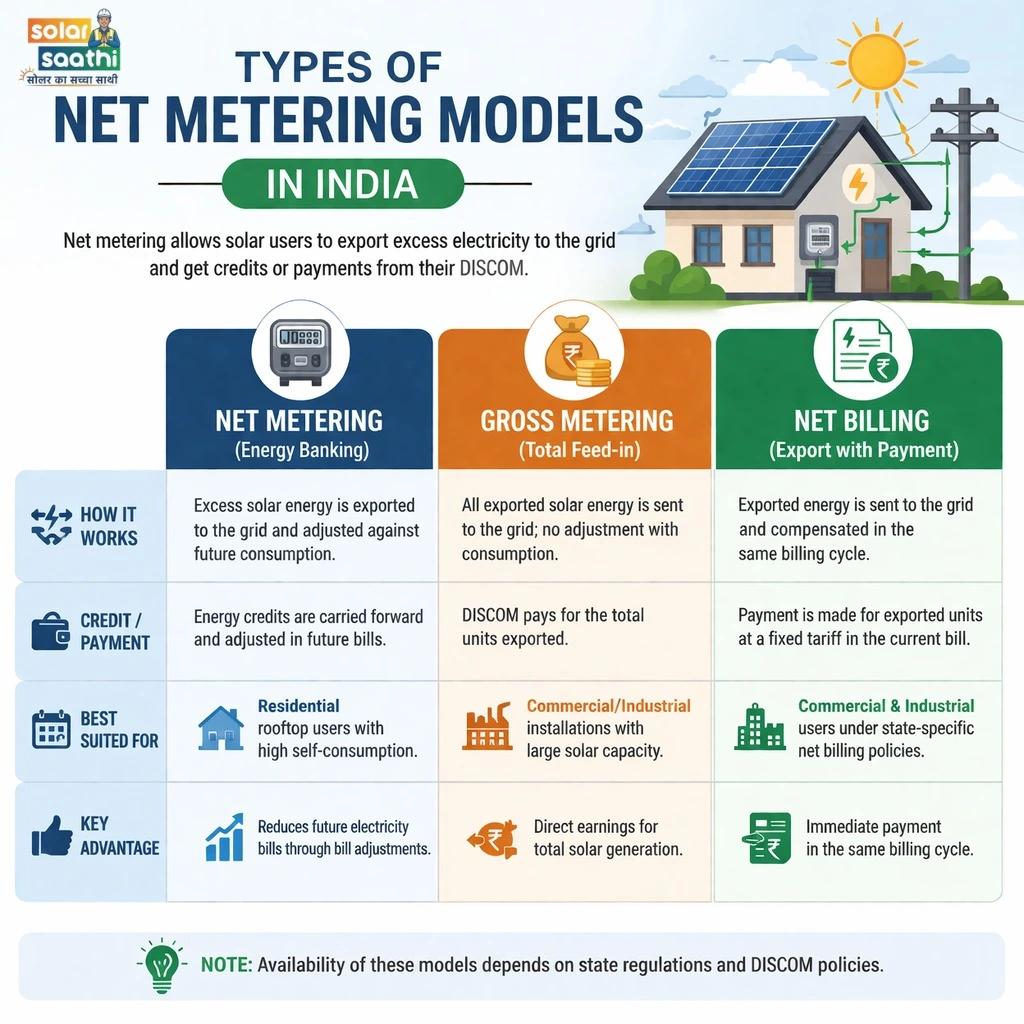
India’s rooftop solar market is growing rapidly under the PM Surya Ghar: Muft Bijli Yojana and various state solar policies. As more homeowners and businesses install solar systems, understanding the difference between Net Metering and Gross Metering has become essential.
Both mechanisms determine how solar energy exported to the grid is measured and compensated, but they can have a significant impact on your electricity savings and project payback period.
What is Net Metering?
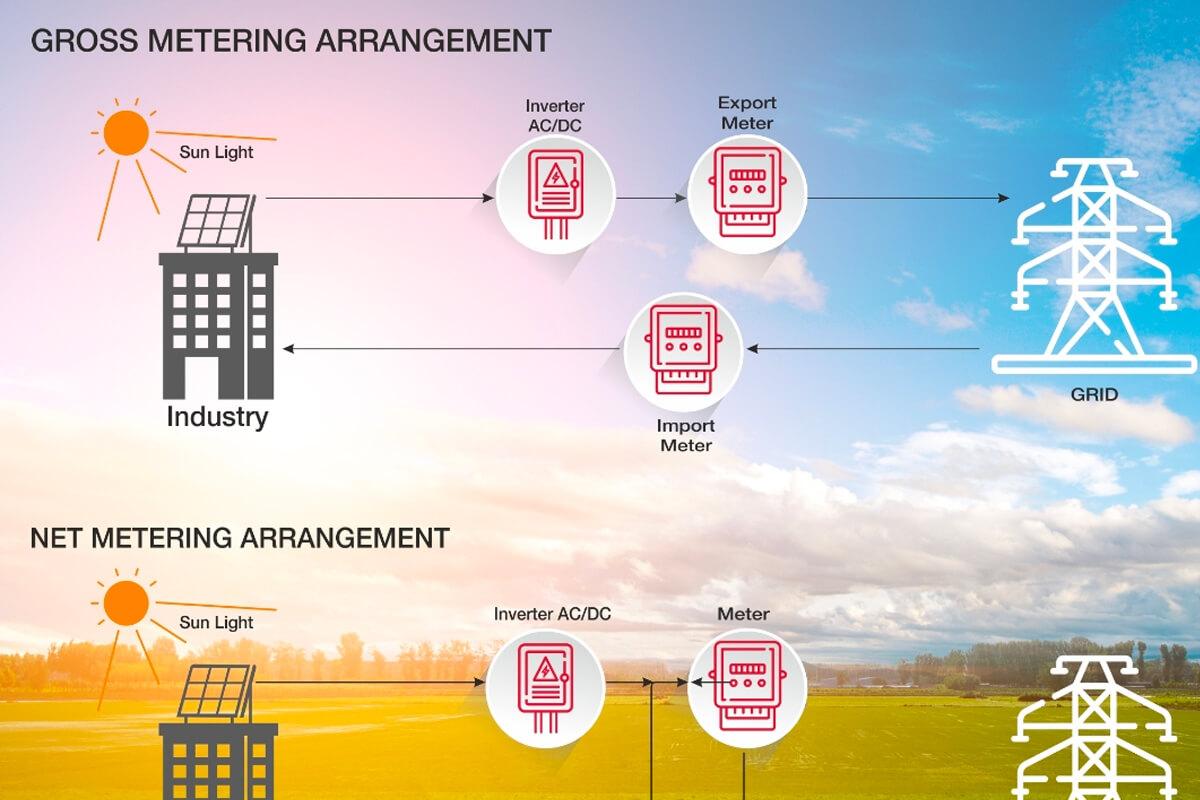
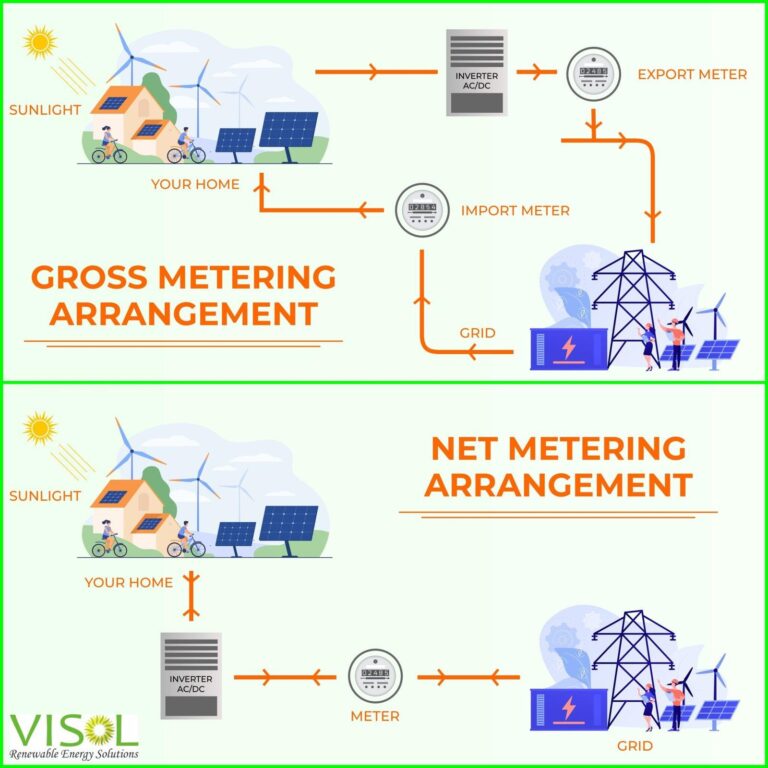
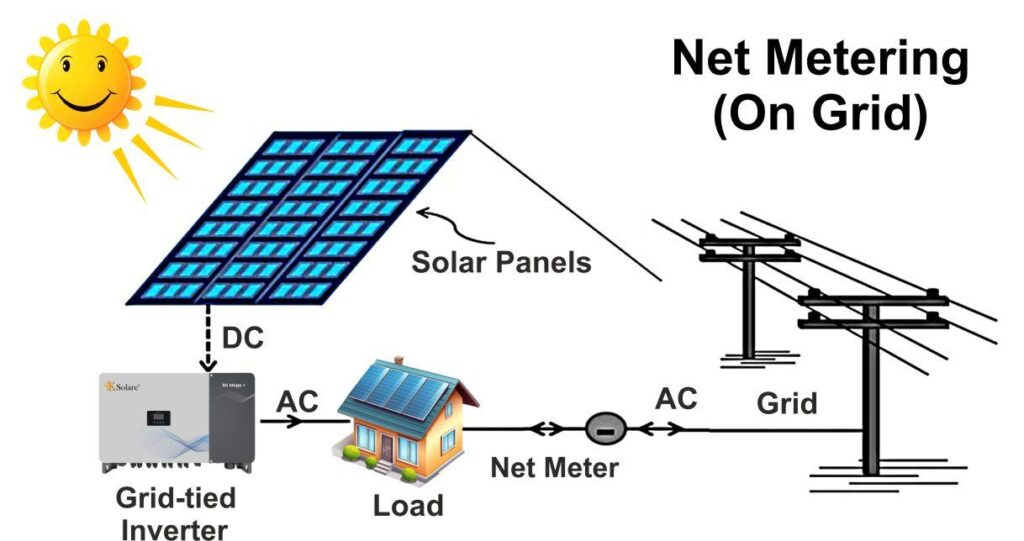
Under net metering, the electricity generated by your solar plant is first consumed within your premises. Any surplus power is exported to the utility grid through a bidirectional meter.
Your electricity bill is calculated based on the net energy consumption, i.e., electricity imported from the grid minus electricity exported to the grid.
Example:
- Solar generation: 500 units/month
- Self-consumption: 350 units
- Exported to grid: 150 units
- Grid consumption: 400 units
Billable units = 400 – 150 = 250 units
This allows consumers to maximize savings by offsetting their own electricity usage.
What is Gross Metering?
In gross metering, the entire electricity generated by the solar system is exported to the grid.
The consumer continues purchasing all electricity required for their home or business from the DISCOM at the applicable retail tariff.
The utility separately pays for the solar energy exported, usually at a predetermined feed-in tariff.
Example:
- Solar generation exported: 500 units
- Electricity consumed from grid: 400 units
The consumer receives payment for 500 units exported and pays the normal electricity bill for 400 units consumed.
Key Differences
| Parameter | Net Metering | Gross Metering |
|---|---|---|
| Solar energy usage | Self-consumed first | Entirely exported |
| Electricity bill impact | Direct reduction in bill | Separate export payment |
| Savings potential | Higher for most consumers | Depends on feed-in tariff |
| Payback period | Generally shorter | Usually longer |
| Best suited for | Homes, apartments, MSMEs | Large institutions with low daytime usage |
| Meter type | Bidirectional meter | Separate import/export accounting |
2026 Regulatory Update
India continues to encourage rooftop solar adoption through simplified net-metering procedures and digital approval systems. Several reforms have reduced paperwork, waived certain charges, and integrated net-metering applications with national solar portals. Net-metering remains the preferred mechanism for most residential rooftop installations under government-supported schemes.
The PM Surya Ghar: Muft Bijli Yojana also supports residential rooftop solar installations and promotes easier grid integration through DISCOM coordination and online processing.
Which Option is Better for Homeowners?
For most Indian households, net metering provides greater financial benefits because:
- Solar power directly offsets household consumption.
- Electricity bills reduce significantly.
- Excess generation earns credits.
- Payback periods are shorter.
- Better utilization of rooftop solar systems.
Many residential consumers can achieve substantial reductions in annual electricity costs through net-metered rooftop systems.
When Does Gross Metering Make Sense?
Gross metering may be suitable when:
- The building has very low daytime electricity consumption.
- The owner wants to operate the solar plant primarily as a power-generation asset.
- Local DISCOM feed-in tariffs are attractive.
- Large institutions or government facilities have specific regulatory requirements.
Practical Recommendation for 2026
For residential consumers installing rooftop solar under PM Surya Ghar, net metering is generally the most economical option. It maximizes self-consumption, lowers electricity bills, and improves project returns.
Gross metering can still be beneficial in specialized cases, but for the average homeowner, net metering remains the preferred choice due to higher long-term savings and faster return on investment.
Both net metering and gross metering support India’s renewable energy transition, but they serve different objectives. Net metering focuses on reducing consumer electricity bills through self-consumption, while gross metering treats solar generation as a separate revenue stream.
Before installing a solar plant, always verify the latest DISCOM regulations and state-specific policies, as implementation details can vary across India. Choosing the right metering mechanism can significantly improve the financial performance of your rooftop solar investment.