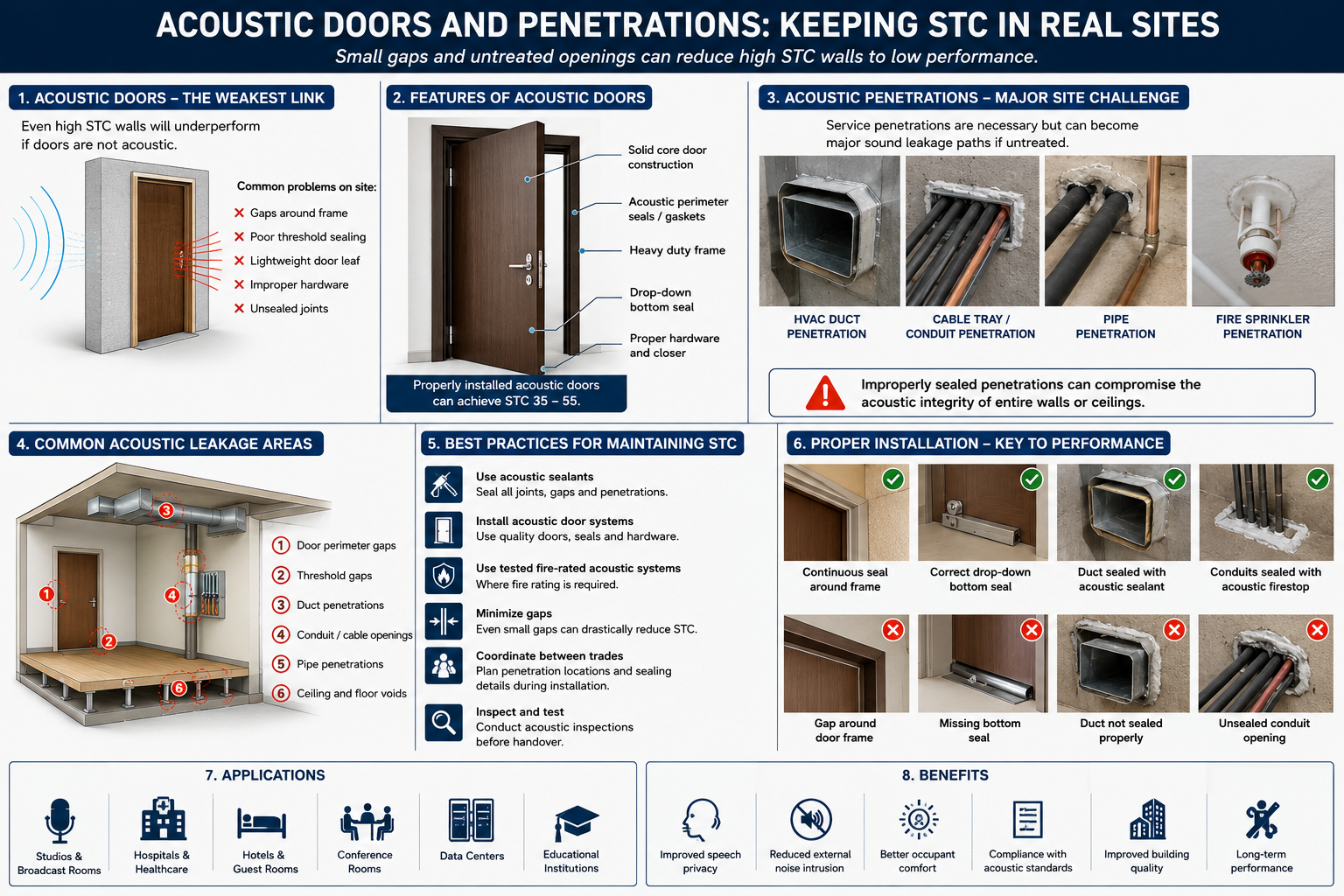
Acoustic Doors and Penetrations: Keeping STC Performance Effective on Real Sites
In modern buildings, acoustic performance is a critical factor for occupant comfort, privacy, and regulatory compliance. While walls and partitions may be designed to achieve high Sound Transmission Class (STC) ratings, the actual site performance often depends on two overlooked elements — acoustic doors and service penetrations.
Even a well-designed acoustic wall can fail to deliver expected sound insulation if doors, cable openings, piping penetrations, or duct gaps are not properly treated. Maintaining STC performance on real construction sites requires careful coordination, proper detailing, and quality installation practices.
Understanding STC in Building Acoustics
Sound Transmission Class (STC) is a rating used to measure how effectively a building element reduces airborne sound transmission.
Higher STC ratings indicate better sound isolation.
Typical Examples
| Construction Element | Approximate STC Rating |
|---|---|
| Standard hollow door | STC 20–25 |
| Solid core acoustic door | STC 35–50 |
| Acoustic partition wall | STC 45–60 |
| Studio-grade construction | STC 60+ |
In actual projects, weak points such as doors and penetrations often reduce the overall acoustic performance of the assembly.
Why Acoustic Doors Matter
Doors are typically the weakest acoustic component in a sound-rated partition. Even high-STC walls can underperform if doors are not properly selected or installed.
Common Problems on Site
- Gaps around door frames
- Poor sealing at thresholds
- Lightweight door construction
- Improper hardware installation
- Unsealed frame joints
These small openings allow airborne sound leakage that significantly reduces overall sound isolation.
Features of Acoustic Doors
High-performance acoustic doors are specially engineered to reduce sound transmission.
Key Features Include
- Solid core construction
- Acoustic seals and gaskets
- Drop-down bottom seals
- Heavy-duty frames
- Multi-layer sound insulation materials
- Precision installation tolerances
Properly installed acoustic doors can achieve STC ratings ranging from 35 to 55 depending on design.
Acoustic Penetrations: A Major Site Challenge
Service penetrations are necessary for building systems, but they can become major sound leakage paths if untreated.
Typical penetrations include:
- HVAC ducts
- Electrical conduits
- Cable trays
- Plumbing pipes
- Fire sprinkler systems
- Data and communication lines
Improperly sealed penetrations can compromise the acoustic integrity of entire walls or ceilings.
Common Acoustic Leakage Areas
HVAC Duct Openings
Duct penetrations can transmit both airborne noise and vibration between rooms.
Cable and Conduit Openings
Even small gaps around conduits can significantly reduce STC performance.
Pipe Penetrations
Rigid pipe connections may transmit vibration and structure-borne noise.
Ceiling and Raised Floor Voids
Unsealed cavities often create indirect sound transmission paths.
Best Practices for Maintaining STC on Site
Use Acoustic Sealants
Flexible acoustic sealants should be applied around all penetrations and frame joints.
Install Fire-Rated Acoustic Systems
Where fire ratings are required, combined firestop and acoustic seal systems should be used.
Minimize Gaps
Even small air gaps can drastically reduce sound isolation performance.
Coordinate Between Trades
Mechanical, electrical, and civil teams must coordinate penetration locations and sealing details during installation.
Conduct Acoustic Inspections
Site inspections help identify weak points before project completion.
Importance of Proper Installation
Acoustic products only perform effectively when installed correctly. Poor workmanship can reduce actual STC performance far below design expectations.
Critical installation factors include:
- Proper alignment of acoustic doors
- Continuous sealing around frames
- Correct compression of acoustic gaskets
- Complete sealing of penetrations
- Isolation of vibrating services
Real-site execution is often more important than laboratory product ratings.
Applications of Acoustic Doors and Penetration Control
These systems are widely used in:
- Recording studios
- Hospitals
- Conference rooms
- Hotels
- Data centers
- Auditoriums
- Educational institutions
- Industrial control rooms
Noise-sensitive environments particularly require strict acoustic detailing.
Benefits of Effective Acoustic Sealing
- Improved speech privacy
- Reduced external noise intrusion
- Better occupant comfort
- Enhanced room functionality
- Compliance with acoustic standards
- Improved building quality perception
Achieving high STC performance in real buildings requires more than just sound-rated walls. Acoustic doors and properly treated penetrations play a critical role in maintaining effective sound isolation on-site.
Without proper sealing, coordination, and installation practices, even premium acoustic designs can fail to perform as intended. By focusing on real-world execution and acoustic detailing, project teams can ensure reliable sound control, occupant comfort, and long-term building performance.