In mission-critical environments like hospitals and laboratories, excessive vibration isn’t just an annoyance—it’s a threat to patient care, research accuracy, and the lifespan of expensive, sensitive equipment like MRI machines and electron microscopes.1
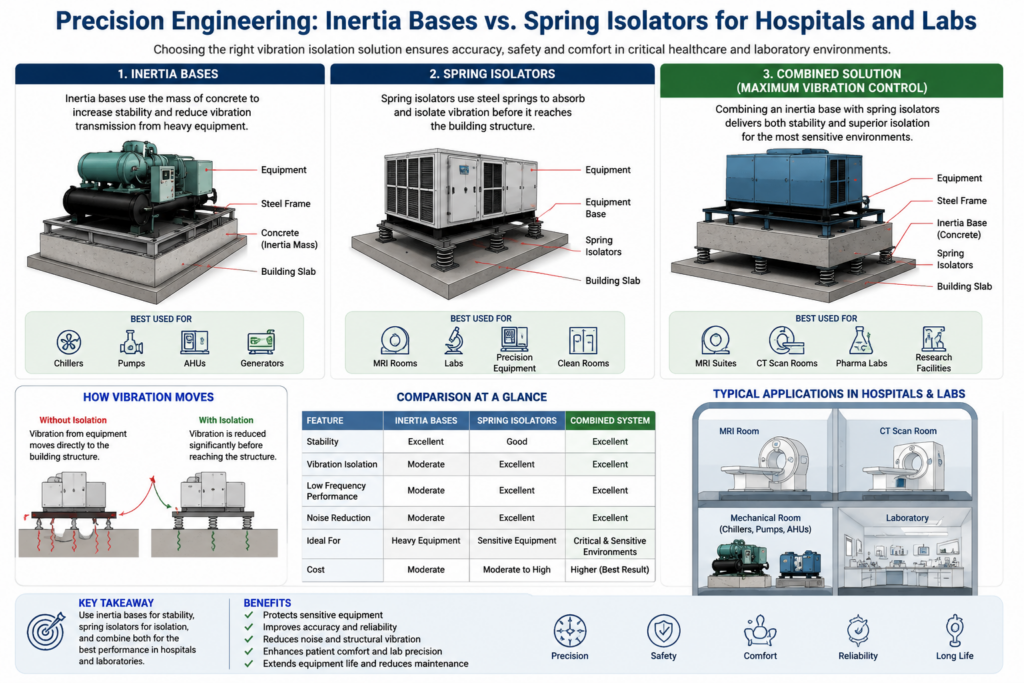
Effective vibration control, especially for HVAC equipment (Chillers, AHUs, Pumps, Compressors), requires a clear strategy. The choice often comes down to two primary components: Inertia Bases and Spring Isolators. However, the gold standard for high-risk applications is often the combination of the two.
At Bhore Engineering Consultants (BEC), our expertise in Noise & Vibration Analysis and MEP Design ensures that critical facilities meet stringent vibration criteria, protecting both people and precision instruments.
The Fundamentals: What Each Component Does
Understanding the distinct role of each component is the first step in designing a fail-safe isolation system.
1. Spring Isolators (The Deflectors)
Spring isolators are the primary isolation mechanism. They consist of helical steel springs designed to absorb and deflect vibration forces away from the building structure. Their main strength lies in achieving a low natural frequency for the isolated system.
| Feature | Function | Relevance to Hospitals/Labs |
| High Static Deflection | Allows the system to vibrate at a very low natural frequency, making it highly effective at isolating low-frequency vibrations (e.g., from slow-running fans or large pumps). | Essential for isolating the deep rumble and mechanical noise that travels long distances through the concrete structure and can disturb patients or sensitive equipment. |
| Isolation Efficiency | Provides high isolation efficiency (often $>95\%$) across the equipment’s operating frequencies. | Directly protects nearby sensitive equipment and ensures patient comfort by significantly reducing transmitted vibration. |