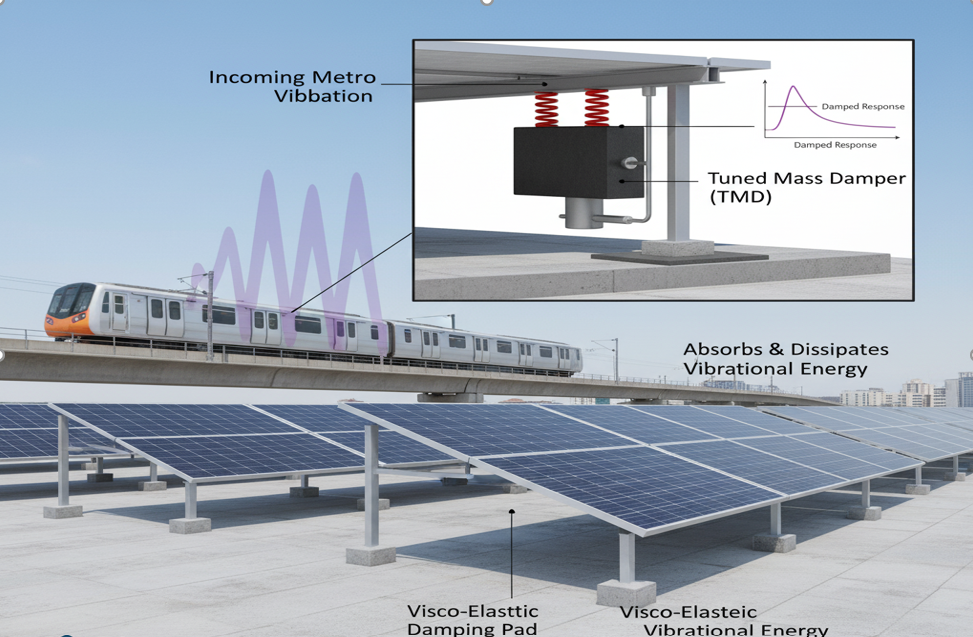
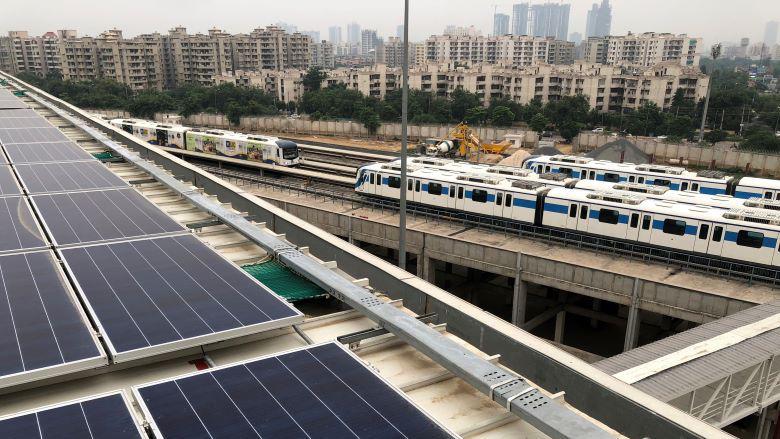
In the push for sustainable urban development, solar photovoltaic (PV) systems are increasingly integrated into city landscapes, often in close proximity to bustling metro lines. While this placement maximizes available space for green energy, it introduces a unique and often overlooked challenge: PV module degradation accelerated by metro-induced vibration.
At Bhore Engineering Consultants (BEC), our expertise lies at the intersection of renewable energy and advanced vibration solutions. We’ve conducted extensive field studies to understand this phenomenon, offering data-driven insights and robust engineering fixes to safeguard your urban solar investments.
The Silent Destroyer: How Vibration Harms Solar Panels
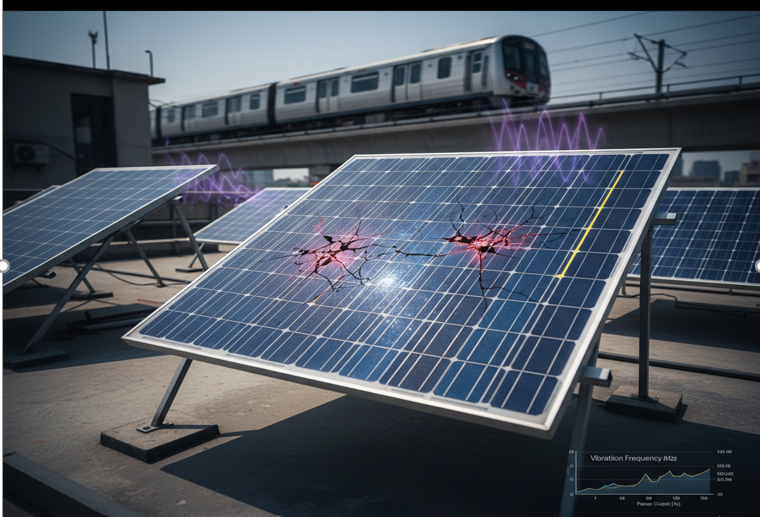
Constant, low-amplitude vibrations from passing metro trains don’t cause immediate, catastrophic failure. Instead, they act as a “silent destroyer,” inducing cumulative stress on the delicate components of a PV module. Our investigations reveal several key degradation mechanisms:
- Microcracks: These are the most prevalent and insidious. Invisible to the naked eye, these tiny cracks form in the silicon cells due to repeated mechanical stress. Over time, they propagate, leading to inactive cell areas and significant power loss.
- Interconnect Fatigue: The metallic ribbons connecting individual solar cells are subjected to constant flexing. This leads to material fatigue, eventually causing open circuits and module failure.
- Delamination: Vibrations can stress the adhesive layers that encapsulate the solar cells, leading to the separation of different layers within the module. This exposes cells to moisture and accelerates other forms of degradation.
This accelerated degradation often goes unnoticed until significant power output is lost, making proactive assessment crucial.
Field Data & Our Findings: The BEC Advantage
At BEC, we don’t just speculate; we measure. Our field studies involve deploying sophisticated real-time vibration monitoring equipment (accelerometers) directly on PV mounting structures located near active metro lines. This allows us to capture the exact frequency and amplitude of vibrations transmitted from passing trains.
We then correlate this vibration data with Electroluminescence (EL) testing of PV modules. EL imaging reveals the presence and extent of microcracks and other defects that impact power generation. Our findings demonstrate a clear and alarming correlation: sites with higher sustained vibration exposure exhibit a significantly higher incidence and severity of microcracks, leading to power degradation that can exceed typical industry standards.
For instance, our work, including projects like the Nagpur Metro Rail where we conducted Noise & Vibration Analysis, has shown that specific resonance frequencies generated by metro traffic can align with the natural frequencies of certain PV mounting structures, amplifying the vibrational stress and accelerating degradation.
As urban infrastructure rapidly expands across India, metro rail networks are increasingly being developed near commercial buildings, industrial facilities, and rooftop solar installations. While metro systems improve urban mobility, they can also introduce an often-overlooked engineering challenge — continuous structural vibration.
For photovoltaic (PV) solar systems installed near metro corridors, repeated low-frequency vibration can gradually affect module performance, mounting stability, and long-term structural reliability. This hidden issue is becoming an important consideration in modern solar infrastructure engineering.